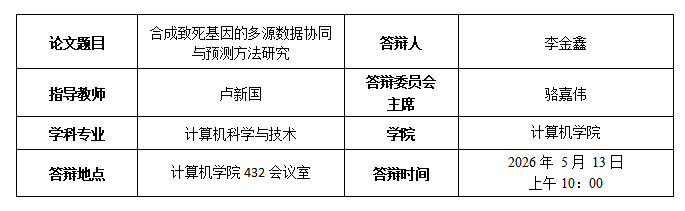
学位论文简介
合成致死描述了两个基因间的一种遗传关联,当两个基因同时突变会导致细胞死亡,否则细胞维持存活。基于合成致死的癌症治疗策略通过药物靶向肿瘤细胞中特定突变基因的合成致死伙伴基因,可以在保留正常细胞功能的同时实现对癌细胞的精准杀伤。因此,发现全新的合成致死基因成为推进精准治疗以及抗癌药物研发的重要基础。随着高通量技术的发展,大量多源异构的生物关联数据被测量和发现,这为合成致死的预测提供了丰富的数据基础,这使得研究人员通过协同多源数据来预测合成致死关联。针对这一背景,本文围绕合成致死基因的多源数据协同与预测问题,从异构数据融合、多模态分布协同、语义关联表征以及临床关联预测四个维度展开系统研究,具体工作如下:
(1) 针对多源异构数据的多层性信息融合困难问题,提出了一种基于层级注意力的数据融合与合成致死预测方法,该方法构建特征、节点和数据源三个层级的注意力机制,实现多源异构数据的自适应融合,提升了合成致死预测结果的鲁棒性。
(2) 针对基因多模态特征的分布具有显著差异性的问题,提出了一种基于生成对抗网络与多模协同的合成致死关联预测方法。该方法构建了模态共享与模态特异的生成编码器,通过消除多模态特征分布差异并提取多模态分布特异性,提升了合成致死基因表征的可鉴别性。
(3) 针对基因表征的语义关联与知识嵌入问题,提出了一种基于潜在空间的合成致死关联预测方法。该方法对利用矩阵三因子分解模型来构建合成致死基因的潜在空间,结合图正则化约束嵌入外部知识,增强了基因表征的语义相关性。
(4) 针对合成致死基因预测缺乏临床关联性的问题,提出了一种基于多视图多组学与图注意力网络的合成致死预测方法。该方法收集了基因不同遗传信息和多组学特征构建关联网络,利用图注意力网络学习不同视图中的临床表征和重要性,实现临床相关的合成致死预测。
主要学术成果
[1] Jinxin Li, Xinguo Lu, Kaibao Jiang, Daoxu Tang, Bin Ning and Fengxu Sun, “TARSL: Triple-attention cross-network representation learning to predict synthetic lethality for anti-cancer drug discovery,” in IEEE Journal of Biomedical and Health Informatics, 2023, 29(3): 1680-1691. (本人一作,导师二作兼通讯,SCI, JCR 1区, top期刊)
[2] Xinguo Lu, Jinxin Li, Zhenghao Zhu, et al., “Predicting miRNA-disease associations via combining probability matrix feature decomposition with neighbor learning,” IEEE/ACM Transactions on Computational Biology and Bioinformatics, vol. 19, no. 6, pp. 3160-3170, 2021. (导师一作,本人二作,CCF B类期刊)
[3] Jinxin Li, Xinguo Lu, Kaibao Jiang, Daoxu Tang, Fengxu Sun and Jingjing Ruan, “Latent space feature representation on multiple biological network for synthetic lethality interaction prediction,” in IEEE International Conference on Bioinformatics and Biomedicine, 2023: 1236-1241. (本人一作,导师二作兼通讯,BIBM 2023, CCF B类会议)
[4] Jinxin Li, Xinguo Lu, Zihao Li, Xing Liu, Hongrui Liu and Jingjing Ruan, “MGANSL: Multi-network representation generating with generative network adversarial network synthetic lethality prediction,” BMC Bioinformatics, 2026, 27(1): 27. (本人一作,导师二作兼通讯,CCF C类期刊)
[5] Jinxin Li, Xinguo Lu, Zihao Li, Xing Liu and Hongrui Liu, “MGATSL: Multi-view graph attention network for synthetic lethality prediction by integrating gene multi-view networks and multi-omics features,” in IEEE International Conference on Bioinformatics and Biomedicine. (在投状态,本人一作,导师二作,BIBM 2026, CCF B类会议)
[6] Xinguo Lu, Guanyuan Chen, Jinxin Li, Xiangjin Hu and Fengxu Sun, “MAGCN: A Multiple Attention Graph Convolution Networks for Predicting Synthetic Lethality,” in IEEE/ACM Transactions on Computational Biology and Bioinformatics, 2022, 20(5): 2681-2689. (CCF B类期刊)
[7] Xinguo Lu, Xinyu Wang, Li Ding, Jinxin Li, Yan Gao and Keren He, “frDriver: A functional region driver identification for protein sequence,” IEEE/ACM Transactions on Computational Biology and Bioinformatics”,2020,18(5): 1773-1783. (CCF B类期刊)
[8] Xinguo Lu, Yan Gao, Jinxin Li, Keren He, Guanyuan Chen, Qiang Qu, “Identification of Cell Types from Single-Cell Transcriptomes Using a Novel Clustering Framework,” Intelligent Computing Theories and Application: 16th International Conference, ICIC2020. (CCF C类, EI)
[9] Xinguo Lu, Yan Gao, Zhenghao Zhu, Li Ding, Xinyu Wang, Fang Liu, Jinxin Li, “A constrained probabilistic matrix decomposition method for predicting miRNA-disease associations” Current Bioinformatics, vol. 16, no. 4, pp. 524-533, 2021. (SCI, JCR 3区)
[10] Xinguo Lu, Fang Liu, Jinxin Li, et al., “An Efficient Computational Method to Predict Drug-target Interactions Utilizing Matrix Completion and Linear Optimization Method,” in International Conference on Intelligent Computing, ICIC2021. (CCF C类, EI)
[11] Xinguo Lu, Fang Liu, Xinyu Wang, Jinxin Li and Yue Yuan, “An Efficient Computational Method to Predict Drug-Target Interactions Utilizing Structural Perturbation Method, “ in International Conference on Intelligent Computing, ICIC2020. (CCF C类, EI)